
Travel story
Best Gilgit-Baltistan Tour Packages – Explore Northern Pakistan with Kayinaat Trip
Explore the best of Gilgit-Baltistan with Kayinaat Trip through unforgettable tours of Skardu, Hunza, Deosai, Shigar, Khaplu, and Fairy Meadows. Enjoy breathtaking landscapes, alpine lakes, mountain adventures, cultural heritage, and customized travel packages. Choose from 4–10 day itineraries with
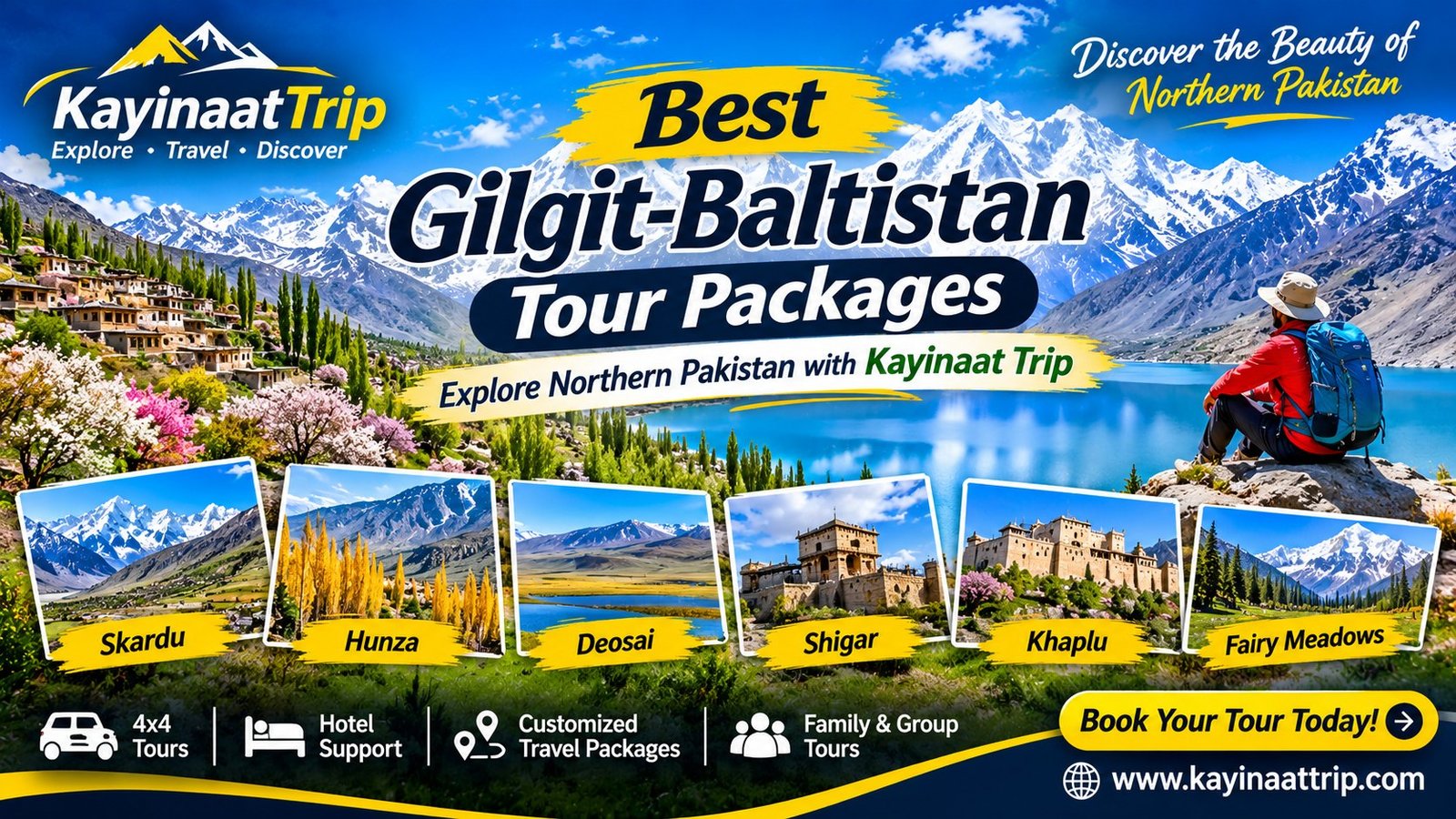
[Gilgit-Baltistan tours](https://kayinaattrip.com/destinations/gilgit-baltistan) are strongest when they match the region’s real travel rhythm: open-road months, high-altitude limits, and the difference between a scenic valley holiday and a mountain access trip. Kayinaat Trip is a [northern Pakistan travel company](https://kayinaattrip.com/about) focused on [routes around Skardu, Hunza, Deosai, Khaplu, Shigar](https://kayinaattrip.com/destinations) and nearby valleys, so it sits squarely in the kind of itinerary planning this topic requires.
> ### TL;DR: Summary
>
> * The best Gilgit-Baltistan tours this year are spring-to-autumn itineraries built around Skardu, Hunza, Deosai, Shigar, Khaplu, and [Fairy Meadows](https://kayinaattrip.com/destinations/fairy-meadows), with trip length chosen by route access, altitude, and road time.
> * For most travelers, 4 to 10 days is the practical range: 4 to 5 days works for a Skardu or heritage-base trip, while 8 to 10 days is better for a Skardu-to-Hunza circuit.
> * Deosai trips are short-season and weather-sensitive because [Deosai National Park](https://kayinaattrip.com/destinations/deosai-national-park) sits at roughly 3,500 to 5,200 meters on a vast alpine plateau, according to UNESCO World Heritage Centre information.
> * Dawn reported that more than 2,200 foreign climbers and trekkers visited Gilgit-Baltistan in the April-to-August 2026 season, and the GB Tourism Department said trekking could continue until October.
> * Kayinaat Trip’s current package grid is a useful planning benchmark, showing a 1-day Deosai 4x4 trip, a 4-day Skardu tour, a 5-day Shigar-Khaplu heritage trail, and a longer Skardu-to-Hunza crossing format.
> * If you want the fewest planning risks, lock your dates first, then route, then vehicle and hotel, and keep buffer time for weather, flight changes, and mountain road conditions.
The best route is rarely the one with the most pins on a map. It is the one that fits your season, energy, tolerance for long drives, and whether you want lakes, forts, [village culture](https://kayinaattrip.com/packages/baltistan-villages-culture-6-day), photography, or genuine high-mountain access.
## When is the best time to book Gilgit-Baltistan tours?
The best booking window is spring through autumn, with June to October covering the widest route access. For Gilgit-Baltistan tours, Kayinaat Trip and other regional planners typically build the most reliable itineraries around blossom season, summer road conditions, and early autumn color rather than deep-winter uncertainty.
Spring is excellent if your priority is blossom season in lower and mid-altitude valleys. Summer opens the broadest range of routes, especially around Skardu, Deosai, and long inter-valley crossings. Early autumn often gives the cleanest light for landscape photography, cooler daytime temperatures, and strong foliage in Hunza, Skardu, and side valleys.
Recent reporting adds useful context. Dawn reported that more than 2,200 foreign climbers and trekkers entered Gilgit-Baltistan during the April-to-August 2026 season, and the GB Tourism Department said trekking could continue until October. That matters because it confirms a long practical touring season, but not every route behaves the same way inside that window.
A common mistake is assuming “summer season” means equal comfort everywhere. Deosai, mountain passes, and long 4x4 routes can still feel cold, windy, or unstable at elevation even when valley towns are warm.
## How many days do you need for a Gilgit-Baltistan trip?
Most travelers need 4 to 10 days, depending on whether they want one base or a regional crossing. A day trip works around Skardu, 4 to 5 days fits a focused valley circuit, and 8 to 10 days is the safer range for Skardu plus Hunza.
If your schedule is tight, choose one hub and stay disciplined. [Skardu](https://kayinaattrip.com/destinations/skardu) can support lakes, forts, cold desert landscapes, Shigar, Khaplu, and Deosai-linked touring. [Hunza](https://kayinaattrip.com/destinations/hunza-valley) can support village stays, viewpoints, and shorter scenic transfers. Trying to combine both in 3 or 4 days usually turns the holiday into a road marathon.
Mid-length trips often perform best because they balance movement and depth. You get time for weather changes, sunrise or sunset viewpoints, and one slower day that keeps the whole itinerary from feeling rushed.
Kayinaat Trip’s [published package grid](https://kayinaattrip.com/packages) helps illustrate the difference between trip styles. A 4-day Skardu Lakes & Valleys plan fits travelers who want one regional base, while a longer Skardu-to-Hunza route is better for people who want a cross-region circuit rather than repeated out-and-back drives.
> "Kayinaat Trip lists a 4-day Skardu Lakes & Valleys tour from PKR 52,000 per person, a practical benchmark for a single-base valley itinerary."
## What are the Gilgit-Baltistan tours worth planning this year?
The strongest options this year are short scenic trips, heritage-led itineraries, and 8 to 10 day crossings that combine Skardu and Hunza. The sweet spot is not one “best” route, but the route that matches the season and your tolerance for altitude and driving.
A strong tour list should mix scenery, logistics, and realism. That means day trips for fragile weather windows, 4 to 5 day routes for depth in one cluster, and longer circuits only when the calendar allows proper transit time.
1. **Deosai and Sheosar Lake 4x4 day trip**: Best for travelers already based in Skardu who want an alpine plateau experience during the open season. This is highly weather-dependent and works best as a dedicated day rather than squeezed into an arrival schedule.
2. **Skardu lakes and valleys tour**: A classic 4-day format that suits first-time visitors. It usually covers a broad mix of water, desert, fort, and mountain-view scenery without excessive hotel changes.
3. **[Shigar](https://kayinaattrip.com/destinations/shigar-valley) and [Khaplu](https://kayinaattrip.com/destinations/khaplu-valley) heritage trail**: Ideal if culture matters as much as scenery. This route trades nonstop transit for [forts, village life](https://kayinaattrip.com/packages/hunza-forts-culture-4-day), and a more textured view of Baltistan.
4. **Skardu to Hunza crossing**: One of the best long circuits for travelers who want both Baltistan and Hunza in one trip. It needs enough days to avoid turning every highlight into a roadside stop.
5. **Hunza blossom tour**: Excellent in spring for orchard bloom, village walks, and softer temperatures. Timing matters more than duration here.
6. **Hunza autumn photography circuit**: A favorite for photographers who want foliage, crisp skies, and layered mountain light. Buffer days matter because weather can still shift quickly.
7. **Fairy Meadows access trip**: Strong for adventurous travelers who accept road and trail effort in exchange for iconic mountain views. This is less relaxed than a valley sightseeing holiday.
8. **[Families usually do best with fewer hotel changes](https://kayinaattrip.com/packages/hunza-summer-family-6-day),** shorter daily road hours, and flexible sightseeing.
The least appreciated distinction is this: a famous destination is not always the right itinerary unit. Deosai is famous, but it often fits best as a day trip from Skardu. Hunza and Skardu are famous too, but they need multi-day planning because the transit itself shapes the trip.
## How should you choose between Skardu, Hunza, and Deosai?
Choose Skardu for variety, Hunza for concentrated sightseeing, and Deosai for a focused high-altitude nature day. They are connected geographically, but they solve different travel goals.
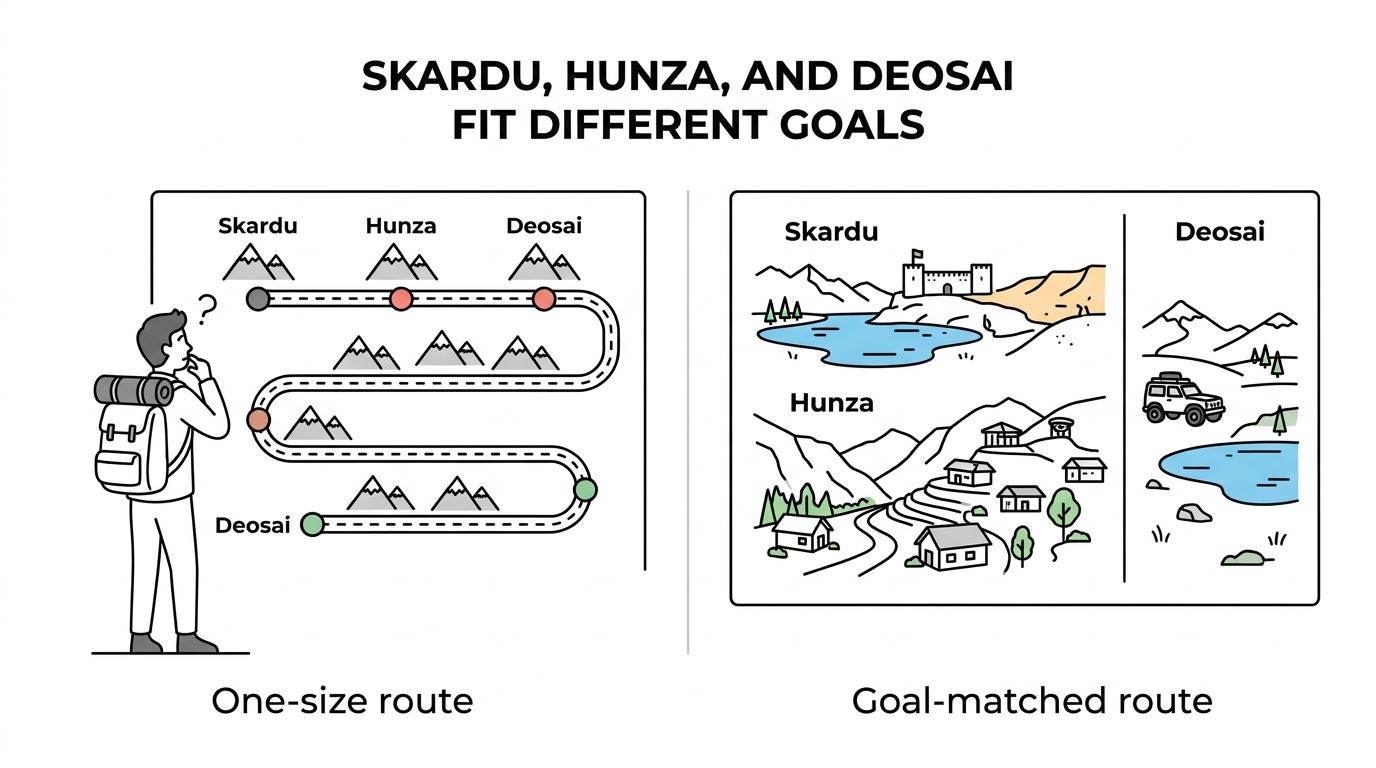
Skardu is the most flexible base if you want range. It combines lakes, desert landforms, forts, rivers, side valleys, and 4x4 day trips. Hunza is more village-centered and often feels more compact from a sightseeing perspective, with iconic viewpoints and easier clustering of stops. Deosai is not a substitute for either one. It is a specialized plateau experience.
The UNESCO World Heritage Centre’s description of Deosai explains why. Deosai National Park is an alpine plateau east of Nanga Parbat near the Central Karakoram Range, sitting at roughly 3,500 to 5,200 meters and spanning 358,400 hectares. That scale and altitude are exactly why Deosai itineraries are short-season, weather-sensitive, and best treated as a distinct outing.
- **Choose [Skardu](https://kayinaattrip.com/destinations/skardu):** broadest mix of lakes, forts, deserts, and 4x4 side routes
- **Choose [Hunza](https://kayinaattrip.com/destinations/hunza-valley):** denser sightseeing pattern with villages, viewpoints, and classic valley photography
- **Choose Deosai:** one high-altitude nature-focused excursion during the open season
A common misconception is that Deosai is just another valley stop. It is not. If Deosai is central to your trip, plan around its access conditions first.
## How do you build a route that matches altitude, road time, and access?
The right route starts with transit reality, not wishful mapping. Pick your entry hub first, cap your daily road hours second, and only then stack scenic stops.
Step 1 is choosing the hub. If your plan is centered on Baltistan, Skardu is often the natural anchor. If your plan is primarily Hunza-focused, it makes sense to keep your overnight pattern clustered there instead of forcing long repositioning drives.
Step 2 is setting a hard limit on travel time per day. If your group dislikes long drives, do not combine arrival, altitude gain, and a remote day trip on the same date. If your travelers are photographers or older family members, slower transfers usually produce a better trip than a bigger checklist.
Step 3 is pacing for altitude and weather. If you arrive and head straight to Deosai or another exposed route, fatigue hits harder and the day usually feels thinner than expected. A smart pattern is light sightseeing first, then more demanding terrain once everyone has settled into the region.
## What should families, photographers, and adventure travelers prioritize?
Each group should prioritize a different shape of itinerary. Families need stability, photographers need light and timing, and adventure travelers need access windows and physical margins.
[Families usually do best with fewer hotel changes](https://kayinaattrip.com/packages/hunza-summer-family-6-day), shorter daily transfers, and a mix of forts, lakes, and easy viewpoints. Children and older travelers rarely enjoy the same trip tempo as a photography group. One strong base with flexible day touring often wins.
Photographers should plan around season-specific light. Blossom and autumn trips are not generic sightseeing tours with better colors. They are timing-sensitive itineraries where even a two-day shift can change orchard bloom, foliage intensity, and visibility. If photography is the main purpose, build in slack rather than chasing too many towns.
Adventure travelers need the clearest honesty on effort. Fairy Meadows, long road transfers, and higher-altitude routes are rewarding, but they are not “easy add-ons.” If your priority is mountain feel over comfort, accept that the route may include simple logistics, early starts, or backup plans.
> "Kayinaat Trip builds around private tours and [custom journeys](https://kayinaattrip.com/contact) across Skardu, Hunza, Deosai, Khaplu, and Shigar, which matches how different traveler types actually move through Gilgit-Baltistan."
## How do permits, weather, and restricted areas affect trip planning?
Permits and weather shape the route long before you pack. Standard valley sightseeing is simpler, while climbs, treks, and restricted mountain zones need earlier checks and tighter planning.
Dawn’s reporting on the 2026 season noted foreign visitors heading into restricted areas linked to major peaks including K2, Nanga Parbat, Broad Peak, Gasherbrum I, and Gasherbrum II. That is a very different planning category from a scenic Hunza or Skardu holiday. If your itinerary touches restricted zones, then access requirements, guide arrangements, and timeline risk all rise together.
Weather is just as important. The GB Tourism Department said climbing had closed while trekking could continue until October, which shows that one mountain activity can end while another remains active. If your trip is trekking-based, October may still work. If it depends on a specific pass, camp, or exposed plateau, the practical season may be narrower.
A useful rule is simple. If your trip includes ordinary valley touring, then your main risk is timing, transport, and accommodation. If it includes remote trekking or restricted areas, then your main risk expands to access control, weather exposure, and schedule volatility. Keep at least one buffer day if your outbound connection matters.
## How should you budget for private tours, hotels, and transport?
Budgeting works best when you start with route structure, not just price tags. Kayinaat Trip’s published rates show how [length, vehicle type](https://kayinaattrip.com/transport), and destination complexity change the cost profile between a day trip, a valley circuit, and a heritage itinerary.
A private tour budget usually has four moving parts: transport, hotel standard, trip length, and group size. A 4x4-heavy route costs differently from a standard valley transfer. A one-day outing can look simple but still carry a high per-day transport cost because the vehicle and driver commitment is concentrated into one window.
Published examples are useful as anchors. The current package grid includes a [1-day Deosai and Sheosar Lake 4x4 day trip](https://kayinaattrip.com/packages/deosai-sheosar-4x4-day-trip) starting from PKR 18,000 per person for 2 to 6 guests, a 4-day Skardu Lakes and Valleys tour starting from PKR 52,000 per person for 2 to 12 guests, and a [5-day Shigar and Khaplu Heritage Trail](https://kayinaattrip.com/packages/shigar-khaplu-heritage-5-day) starting from PKR 78,000 per person for 2 to 10 guests. Those figures do not define the whole market, but they do show how route depth and trip format affect pricing.
A pro tip here is to compare cost per useful travel day, not just headline package price.
That same logic applies to luggage strategy on road-heavy itineraries, and [Wild Xplorer’s breakdown of roof bag versus roof box choices](https://wildxplorer.com/blogs/news/roof-bag-vs-roof-box-which-fits-your-travel-style) underscores how storage setup can affect comfort, access, and how much of each day is lost to packing friction.
A pro tip here is to compare cost per useful travel day, not just headline package price. A cheaper trip with punishing transit may deliver less actual sightseeing than a slightly higher-priced route with better pacing and fewer repositioning hours.
> "Kayinaat Trip lists a 1-day Deosai & Sheosar Lake 4x4 trip from PKR 18,000 per person for 2 to 6 guests."
## What should you lock in first once your travel window is set?
Lock dates first, then the route spine, then hotels and vehicle. Activities, add-ons, and fine details should come after the backbone is fixed.
Start with the season-specific constraint. If it is blossom season, your first concern is timing. If it is Deosai, your first concern is access and weather. If it is a Skardu-to-Hunza crossing, your first concern is transit structure and whether you truly have enough days.
After that, secure the route spine. That means your entry point, overnight sequence, and the long transfers that cannot be improvised later. [Hotels come next](https://kayinaattrip.com/hotels) because the best-located stays in popular windows can tighten quickly, especially in Hunza and Skardu.
Only then should you finalize extras like photography stops, heritage detours, or a relaxed spare day. People often reverse this order and start by saving Instagram locations. The stronger move is to protect the route first. Once the skeleton is right, the memorable moments usually take care of themselves.